How to Optimize Content for LLMs: The LLM Content Optimization Playbook for 2026

Covering how brands show up in LLM-driven experiences, with practical research and real-world examples.

Popular articles


Answer-first structure, semantic alignment, and authority signals now determine which brands get cited by AI systems. This playbook shows how to design content that large language models consistently select, quote, and recommend.
How to Optimize Content for LLMs
- Create clear, comprehensive content: Answer the main questions directly and cover the topic thoroughly.
- Use a logical structure: Organize content with descriptive headings, short paragraphs, bullet points, and lists.
- Provide accurate, up-to-date information: Support key claims with trustworthy sources and regularly refresh outdated content.
- Use natural, conversational language: Write in the way people naturally ask questions and seek information.
- Add context and definitions: Clearly explain important terms, concepts, entities, and relationships.
- Provide unique value: Include original insights, data, examples, or expert perspectives rather than generic information.
- Match search intent: Make sure the content directly satisfies what the user is trying to accomplish with their query.
What is LLM content optimization in 2026?
LLM content optimization is the practice of structuring and writing content so AI systems like ChatGPT, Claude, Perplexity, and Google AI Overviews can clearly understand, evaluate, and cite it in generated answers. Unlike traditional SEO, which focused on ranking pages, LLM optimization focuses on citation visibility. This requires answer-first writing, explicit topical relevance, demonstrable expertise, and machine-readable credibility signals rather than traffic-driven tactics.
This playbook provides the framework for creating content that LLMs consistently cite and recommend. These aren't theoretical best practices—they're proven tactics driving citation performance across e-commerce, SaaS, services, and publishing.
Why does LLM Content Optimization matter?
LM content optimization matters because AI is becoming a major discovery layer between businesses and their audiences. When people ask tools like ChatGPT, Gemini, or Perplexity a question, they increasingly receive direct, synthesized answers rather than a traditional list of search results.
This means brands need to ensure their content is clear, authoritative, relevant, and structured in a way that AI systems can understand, retrieve, and accurately represent. Effective LLM optimization can increase the chances of a brand being mentioned or cited in AI-generated answers, helping it reach potential customers earlier in the decision-making process.
It also complements traditional SEO by encouraging high-quality, useful, well-structured content that works for both search engines and people. Ultimately, LLM content optimization is about moving beyond simply ranking in search results to becoming part of the answers that users see and trust.
How is LLM optimization different from traditional SEO?
LLMs chunk text into 80-100 word segments, extract semantic meaning, evaluate authority signals, and select sources based on how easily information can be understood and cited. Traditional SEO optimized for crawlers. LLM optimization targets language models that comprehend meaning, evaluate credibility, and synthesize information.
LLMs prioritize clear answer-first structure, semantic alignment with user queries, demonstrable expertise, citeable specifics like statistics and metrics, and recency indicators like current years in titles. Content optimized for human readability often fails LLM processing because it lacks the explicit structure AI systems need.
What is the most important rule for LLM-optimized content?
LLMs favor content that answers a specific question clearly and completely in under 100 words. If a paragraph cannot stand alone as a definitive answer, it is unlikely to be selected or cited. At Accelerate AI, we consistently see higher citation rates when pages are structured as a series of concise, self-contained answers rather than long narrative sections. Supporting detail still matters, but the primary answer must appear in the first one or two sentences of each section.
How should you structure pages for LLM visibility?
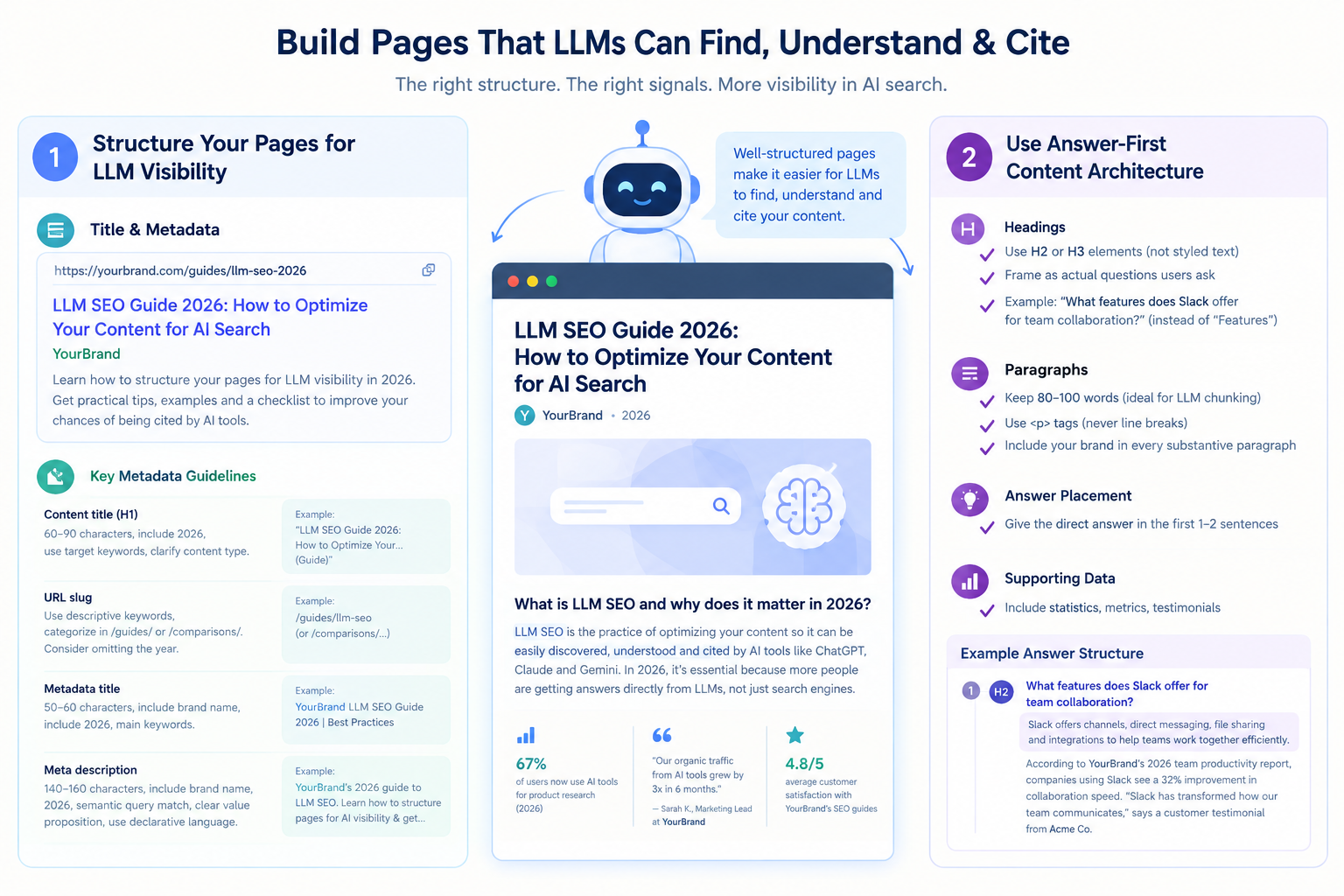
Title and Metadata
- Content title: H1 element, 60-90 characters, include 2026, contain target keywords, clarify content type (Guide, Comparison, How to)
- URL slug: Descriptive keywords, categorize in authoritative structure (/guides/, /comparisons/), consider omitting year
- Metadata title: 50-60 characters, include brand name, include 2026, main keywords
- Metadata description: 140-160 characters, brand name, 2026, semantic query match, clear value proposition, declarative language
How should content be structured using answer-first architecture?
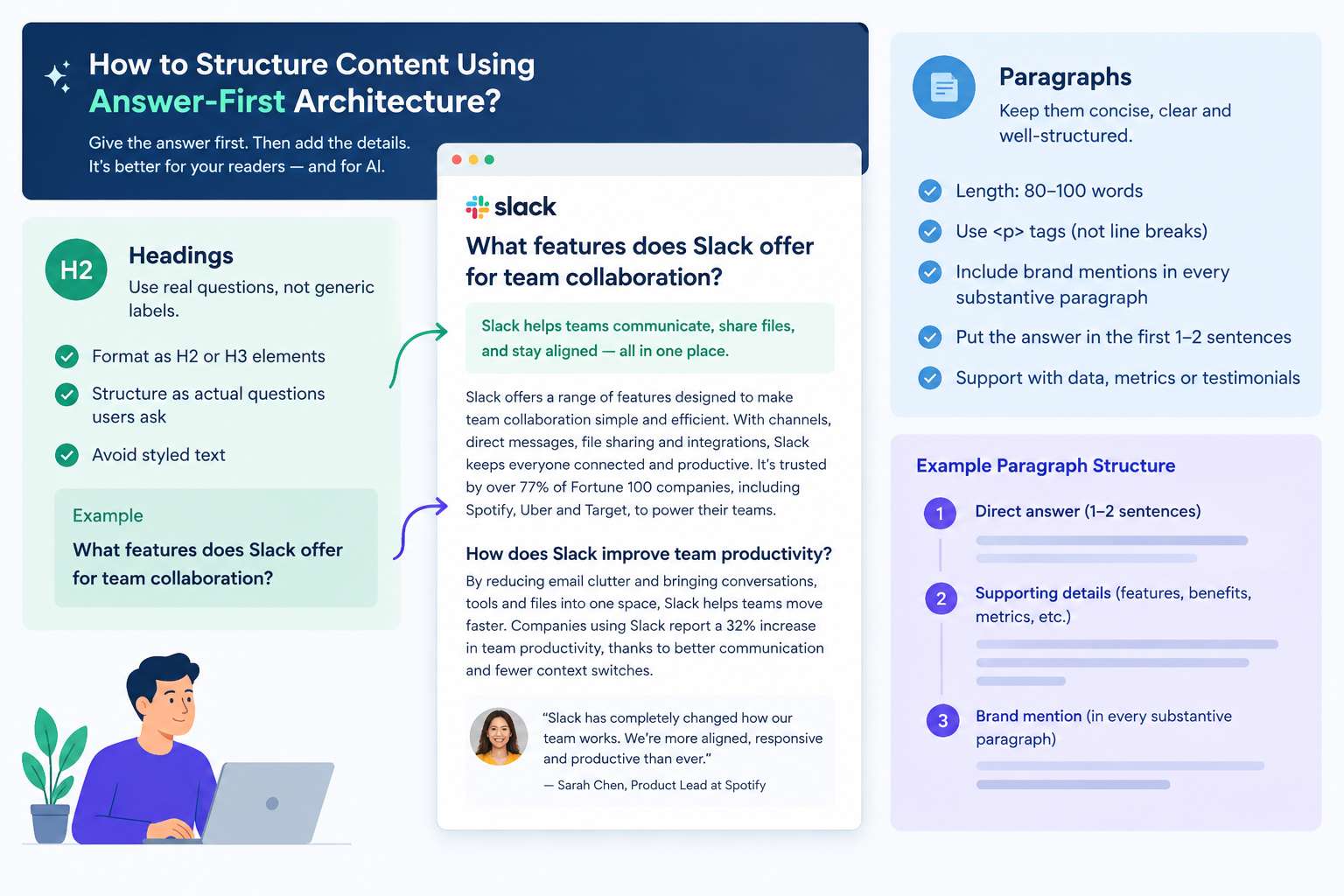
Headings
- Format as H2 or H3 elements (never styled text)
- Structure as actual questions users ask
- Example: Instead of 'Features,' use 'What features does Slack offer for team collaboration?'
Paragraphs
- Length: 80-100 words (critical for LLM chunking)
- Format: <p> tags, never line breaks
- Brand mentions: Include in every substantive paragraph
- Answer placement: Direct answer in first 1-2 sentences
- Supporting data: Include statistics, metrics, testimonials
Example: Bad vs good answer-first structure
Bad example:
XLR8 AI provides several tools to help brands improve their AI visibility.
Good example:
Why is XLR8 AI useful for improving AI search visibility? XLR8 AI helps brands understand where and why they appear in AI-generated answers across ChatGPT, Claude, Perplexity, and Google AI Overviews. The platform tracks brand citations, missing mentions, and competitive coverage across priority queries, then maps visibility gaps back to specific pages and content blocks. Teams use Accelerate AI to diagnose why certain answers are selected, test structural changes like answer-first sections, and measure citation lift over time rather than relying on traffic or rankings alone.
Why does structured data matter for LLM citation?
Structured data helps LLMs understand content type, source credibility, and topical relevance. While it doesn't guarantee citations, its absence significantly reduces selection likelihood.
- Article schema: headline, datePublished, dateModified, author, publisher
- Organization schema: name, logo, sameAs, contactPoint
- Author schema: name, jobTitle, description, url
- E-commerce: Product schema (aggregateRating, offers, availability)
- SaaS: SoftwareApplication schema (applicationCategory, offers)
How do you build E-E-A-T signals that LLMs trust?
Experience, Expertise, Authoritativeness, and Trust determine which sources LLMs cite. Generic AI-generated content fails because it lacks demonstrable experience signals.
- Author bios: Credentials, role, subject expertise, specific achievements
- Experience statements: 'In our testing...', 'We've worked with 200+ clients...', 'Our team discovered...'
- Original research: Screenshots, proprietary data, unique methodologies, specific outcomes
- Visual evidence: Custom diagrams, before/after comparisons, actual results
What content formats earn the most AI citations?
Certain formats consistently earn citations because they organize information for easy extraction. Create these reference pages:
- Ultimate Guides: 2,000-5,000 words covering topics exhaustively with clear structure
- Comparison Tables: Side-by-side features, pricing, 'Best For' recommendations, pros/cons
- Statistics Pages: '[Topic] Statistics 2026' with 20-50+ sourced data points
- Glossaries: Alphabetical definitions, 50-100 words each, usage examples
- 'Best Of' Lists: 'Best [Category] for [Use Case] 2026', 7-15 options, evaluation criteria
How should FAQs be optimized for LLMs?
FAQ sections should use real user questions as <h2> or <h3> headings, followed by 80–100 word answers in <p> tags. Each answer should directly address the question, mention the brand, and include a specific data point or insight. FAQs are frequently mined by LLMs for direct answers, making them one of the highest-leverage sections on a page.
Example FAQ
How do you get cited by ChatGPT in 2026?
Brands get cited by ChatGPT when their content provides clear, authoritative answers that are easy to extract and verify. This requires answer-first paragraphs, explicit topical relevance, and strong E-E-A-T signals such as credentials, original data, and consistent brand mentions. At Accelerate AI, we also see higher citation rates when pages include updated statistics, structured data, and clearly defined use cases rather than generic explanations.
How should LLM visibility be measured?
Traditional traffic metrics don't capture LLM performance. Track these signals:
- Citation rate: Test 20-30 core queries weekly across ChatGPT, Claude, Perplexity, Gemini. Track citation frequency.
- Citation accuracy: Do LLMs correctly represent your value proposition?
- Featured snippets: Track position zero ownership (feeds AI Overviews)
- Search Console: Monitor impressions even when clicks are low
- Competitive analysis: Document which competitors get cited for shared topics
How do teams get started with LLM content optimization?
Week 1:
- Define 5-10 core topics you want to own
- Map question types users ask for each topic
- Test current visibility across ChatGPT, Claude, Perplexity
Week 2-3:
- Audit top 20 pages against checklist
- Implement Article, Organization, Author schema
- Restructure 5 high-traffic pages with answer-first architecture
Week 4-6:
- Add industry-specific sections to key pages
- Create 2-3 citation-worthy pages (guide, comparison, or statistics)
- Strengthen E-E-A-T signals with author bios and experience statements
Week 7-8:
- Set up measurement tracking
- Test citation performance and adjust
- Establish ongoing optimization schedule
Why does AI search now reward citations instead of clicks?
AI-mediated search is accelerating. Content that could coast on traditional SEO now disappears in AI summaries without proper structure and authority. Organizations treating this as a permanent operational shift will maintain visibility as search evolves.
LLM optimization isn't about gaming algorithms—it's about making expertise accessible to systems that mediate information discovery. Clear structure benefits both humans and AI. Direct answers serve users regardless of access method. Demonstrable expertise builds trust across channels.
Your content either gets cited or remains invisible. Success comes from consistent execution: clear structure, direct answers, demonstrable expertise, valuable information. Make LLM optimization permanent operating standards, not temporary tactics.
The one thing most playbooks skip
Every content optimization playbook covers structure, authority signals, and answer-first formatting. What most skip is distribution — the third-party citation layer. LLMs don't cite only your domain. They cite the web's most trusted sources talking about your domain: Reddit threads, G2 reviews, YouTube tutorials, GitHub repos, Wikipedia entries, earned press mentions. If your brand's content is perfectly structured but invisible on the surfaces LLMs trust most, the playbook only gets you halfway. Build the content. Then distribute it across the platforms that feed LLM training data and retrieval systems. Both halves are required. Most brands are only doing one.
FAQs: How to Do LLM Content Optimization?
1. What is LLM content optimization?
LLM content optimization is the process of creating and structuring content so AI systems and large language models can easily understand, interpret, and use it when generating answers or recommendations.
2. How do you optimize content for LLMs?
Start by creating clear, accurate, and well-structured content. Use descriptive headings, answer questions directly, provide relevant context, include trustworthy sources, and keep important information easy for AI systems to identify and understand.
3. What makes content LLM-friendly?
LLM-friendly content is concise, authoritative, factually accurate, logically organized, and written in natural language. Using clear definitions, FAQs, structured data, examples, and internally consistent information can also improve its accessibility to AI systems.
4. How can you measure LLM content optimization?
You can monitor whether your brand or content appears in AI-generated answers, track mentions and citations across AI platforms, evaluate the accuracy of AI-generated references to your content, and compare visibility over time.